SIG 11 Large-scale Studies in Science Education (LASSIE) approved
I am happy to share that during the last ESERA Board meeting, the proposal for a new Special Interest Group (SIG) on Large-scale Studies in Science Education was accepted.
I was invited by Professor Nani Teig to help with the application for this SIG, and I am grateful to her for the idea and for all the work she put into the process. Now that it has been accepted, we are looking forward to starting the dialogue with others who share the same interest in large-scale studies.
Information about the new SIG is provided below, and ESERA members will be able to register through the members area.
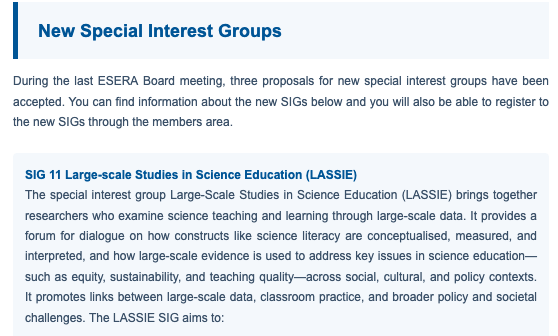
SIG 11 Large-scale Studies in Science Education (LASSIE) The special interest group Large-Scale Studies in Science Education (LASSIE) brings together researchers who examine science teaching and learning through large-scale data. It provides a forum for dialogue on how constructs like science literacy are conceptualised, measured, and interpreted, and how large-scale evidence is used to address key issues in science education—such as equity, sustainability, and teaching quality—across social, cultural, and policy contexts. It promotes links between large-scale data, classroom practice, and broader policy and societal challenges. The LASSIE SIG aims to:
- Advance theoretical and conceptual understanding of how large-scale studies define, operationalise, and interpret constructs related to science teaching and learning.
- Promote critical discussion of assessment frameworks, validity, and cultural relevance of large-scale studies and their implications for science education research, curriculum, and policy.
- Support methodological innovation through dialogue on analytical approaches, data linkage, and integration of large-scale data with other forms of evidence.
- Facilitate international and interdisciplinary collaboration among researchers, institutions, and organisations to strengthen the scientific and policy impact of science education research.
- Build research capacity by organising training and dissemination activities as well as mentorship on theoretical and methodological aspects of large-scale studies.
- Foster an active and inclusive community that shares resources, data practices, and research findings across contexts.
- Promote ethical, equitable, and transparent use of large-scale data in science education.
- Bridge collaboration between science education researchers and organisations conducting large-scale studies (e.g., OECD, International Association for the Evaluation of Educational Achievement [IEA]).
Coordinators: Nani Teig and Matheus Monteiro Nascimento